Life takes on a familiar rhythm during lambing, with the daily routines we have developed to support our mothers and their lambs through the lambs’ early life.
First thing in the morning, Melinda and Lolo check the “drop pen” in the barn, where the expectant mothers spent the night, to see if any ewe is in labor, or may have had her lamb in the past few hours after our last camera-check of the night. If there are no births or newborns to attend to, they put the expectant mothers out to pasture for the day, and then Melinda goes around the ranch feeding and checking on all the other sheep, the dogs, the cats and chickens.
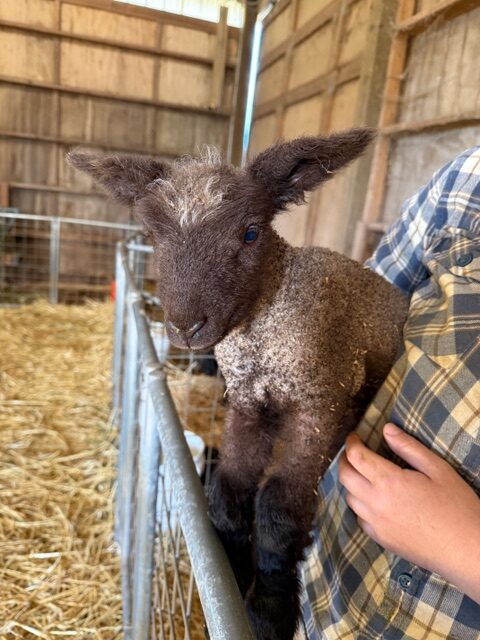
After the morning routine comes “rounds,” our daily check of the lambing jugs where the mothers and lambs stay for the lambs’ first 3 days. We keep a chart with all the lambs listed, along with their sire and dam, their birth-date and time, sex, birth-weight, and a check-list of all the treatments we give them in the first 3 days. On day 1, the lamb gets a shot of selenium and vitamin E, because we are in a selenium-poor part of the country and selenium is essential for health, as is vitamin E. The mother gets treated with wormer, so that she will go out to pasture free of any parasites she may have been carrying. We check the lamb’s eyes to be sure that it doesn’t have entropion, a condition in which the lower eyelid rolls into the eye, that can cause blindness if not caught and corrected. It can be easily corrected by manually rolling out the eyelid and holding it for a few moments, or in more severe cases, by giving an injection to puff out the eyelid for a day or so. We check that the lamb’s umbilical cord has been dried up with the iodine treatment it was given at birth to prevent infection, and re-treat if it is still moist and fleshy. And we check to be sure that the mother is keeping her lamb’s butt clean of poops, because the lamb’s first poops are very gluey and can stop up their butt if not cleaned off. On day 2, we check eyes, cord and butts again, and then on day 3 the lamb gets its ear-tag and, if it is a recessive-colored Romney lamb, a set of birth photos to help document the lamb’s color patterns, which enable us to determine the recessive color alleles it is carrying.
Melinda holding one of Bronte's moorit ewe-lambs during day 2 rounds
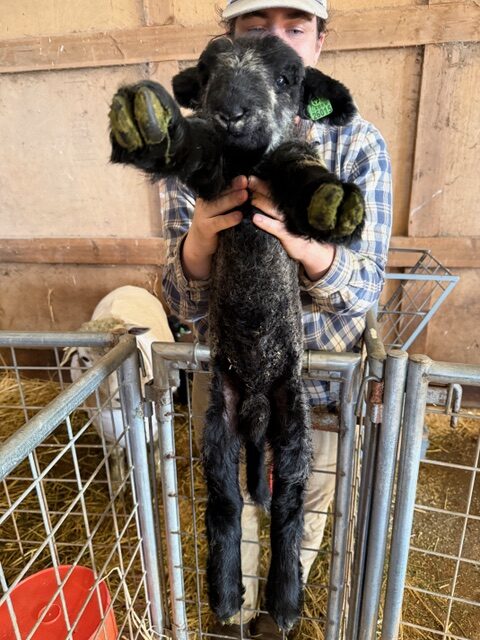
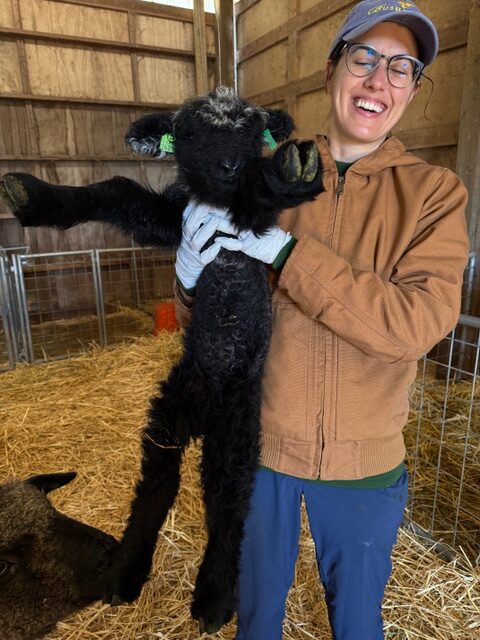
There are a set of 7 photos we take of every recessive-colored lamb. One of those is the “full belly” shot! Below, Melinda and Laura hold lambs for their full-belly shots.
The ewe gets a clean coat to protect her fleece (we take the coats off when the ewe is in the jug, to make sure no lambs get hung up on leg straps when they are learning to nurse), and the ewe and lambs are ready to go out into the world.
First, the day-3 lambs and their mothers are released into the drop-pen area immediately outside the jugs, for the lambs to recover from the shock of their day-3 treatments. They also have had bands put on their tails that will block blood flow and cause the tail to fall off in a few weeks (a bloodless way of docking tails for hygiene), and if they are boys that I don’t want to save as rams, they have also had a band put on their scrotum for bloodless castration. All that makes them uncomfortable for an hour or so and we let them recover in the familiar surrounding of the barn before they make their first big migration, to the other barn whether they will join what we call a “mixing group” of mothers and lambs 3-7 days old. That group stays in the barn at night and goes out to a sheltered pasture during the day.
We then get busy cleaning the jugs and drop-pen, stripping completely the jugs that have been vacated and re-bedding them for their next occupants.
Later in the day, the 3-day-old lambs go outside for the first time, to make the trip to the other barn and start to make friends in the mixing group.
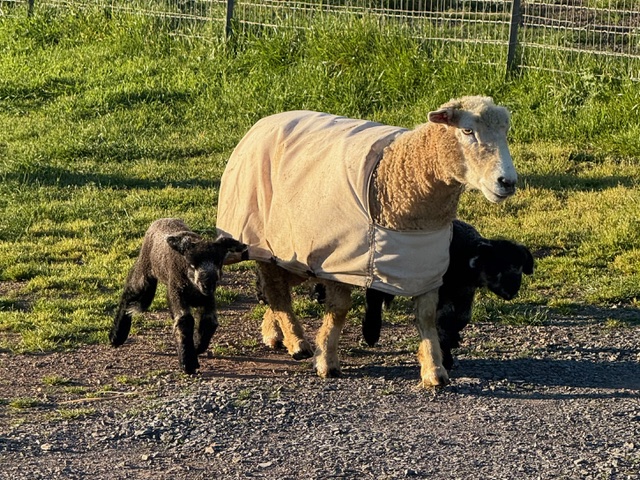
Bronte and her two moorit girls, sporting their new eartags, head down the alley to meet the mothers and lambs in the mixing group
The mixing group has no dog to protect them, but they are locked in the barn at night, safe from predators, and during the day they go out to a small, sheltered paddock where they are protected and we can keep an eye on them.
Lambs learn to socialize in the mixing group, leave their mothers to play, and then find them again
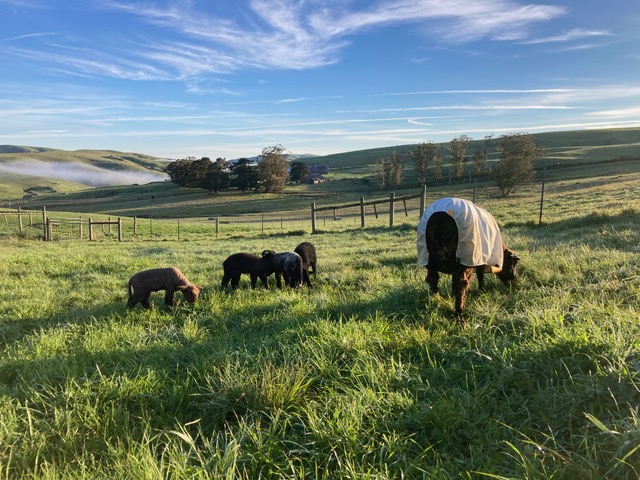
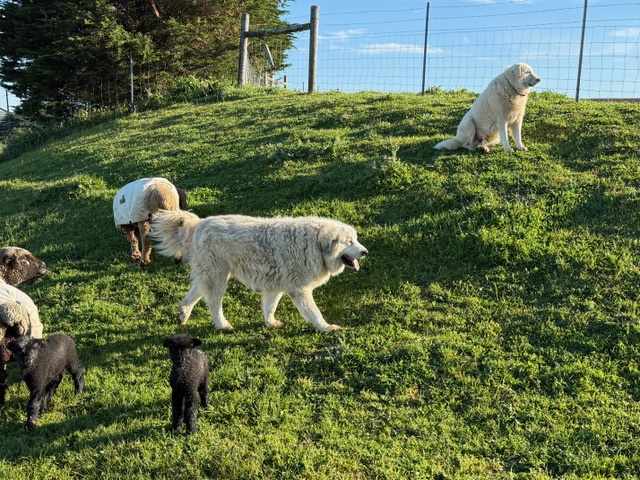
Every morning when we put the mixing group out of the barn for the day, we hold “promotions” for the 7-day-old lambs and their mothers. At 7 days old, the lambs go with their mothers to the big Hilltop pasture where they will stay out day and night, guarded by our trusted dogs, Owen and Oakley.
Pearl, with her triplets close at her side (one is hidden behind her) heading to the Hilltop pasture
Oakley and Owen greet the day's new additions to their flock
As the day draws to a close, Lisa comes to take over for Melinda and me, and do the late-afternoon/evening shift. She feeds the dogs, checks on all the sheep in the pastures, checks the mothers and lambs who are out in the Hilltop pasture and counts the lambs to be sure they are all OK. She brings in the mixing group and gives them some alfalfa to keep them through the night, and feeds the ewes in their jugs and, at sunset, brings in the expectant ewes to the drop pen for the evening.
Of course, our predictable daily rhythms of lambing-time are punctuated by the unpredictable–the births themselves! And lately, Lisa has had more than her share happening on her watch. (to be continued…)